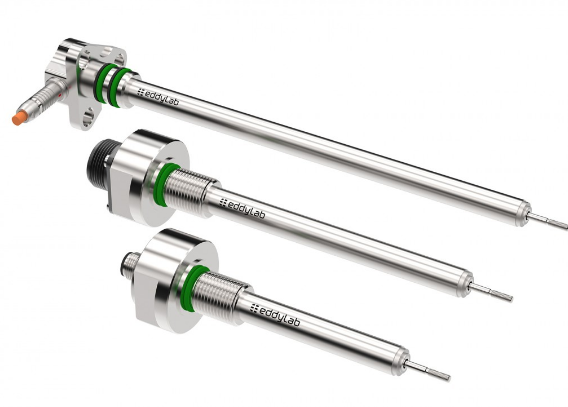
| Fig. Inductive Transducers (source: eddylab.com) |
Inductive Transducers
In Inductive transducers, the basic principle is that self-inductance of a single coil or the mutual inductance between two coils is changed by a quantity to be measured i.e. measurand. Usually, the measurand could be a rotary or linear displacement, force, pressure, torque, velocity, acceleration and vibration.
For example, LVDT is a inductive transducer which measures the displacement in terms of voltage difference.
Inductive transducers works on one of the following principles for its working.
(a). Change of self-inductance
(b). Change of mutual inductance
(c). Production of eddy current
Change of Self Inductance of Inductive Transducer
As we know that self-inductance of a coil is given by
Where, N is the number of turns, and
R = reluctance of the magnetic circuit.
Also, reluctance of the magnetic circuit is given by
Therefore, equation of inductance becomes,
Let G = A/l, known as geometric form factor
A = cross-sectional area of coil
l = length of coil
μ = permeability of the medium
therefore,
So, by variation in number of turns, N or geometric configuration, G or permeability, μ , the self-inductance can be changed.
For example, if some displacement is able to change the above parameters then displacement can be directly measured in terms of inductance.(There is a calibration of instrument against measurand).
Change of Mutual Inductance of Inductive Transducer
In this principle, when two or more coils are mutually coupled then mutual inductance can varied by changing the self-inductance of the coils. Lets take two coils having self inductance L1 and L2. Then mutual inductance is given by
where, K = coefficient of coupling
So, mutual inductance can be varied by changing the self-inductance of the coils or coefficient of coupling (K). Coefficient of coupling (K) depends on the distance and orientation between the two coils.
In case of displacement measurement, one coil can be fixed and other coil should connect to moving object. When this object moves, the Coefficient of coupling (K) will change and hence there is change in mutual inductance. The mutual inductance can be calibrated in terms of displacement for measurement.
Production of Eddy Current of Inductive Transducer
This is based on the fact that if a conducting plate is placed near a coil carrying alternating current then Eddy currents are produced in the plate. The plate carrying eddy current produces their own magnetic field which acts against coil magnetic field. This will results in reduction of magnetic flux and hence coil inductance reduces. If the coil is nearer to the plate then higher eddy current are produced and hence greater reduction in coil inductance. So, by varying the distance between the plate and coil, coil inductance changes. This principle of varying the distance of plate or coil using measurand is used in displacement measurements.